
info@raynerdiesel.co.uk
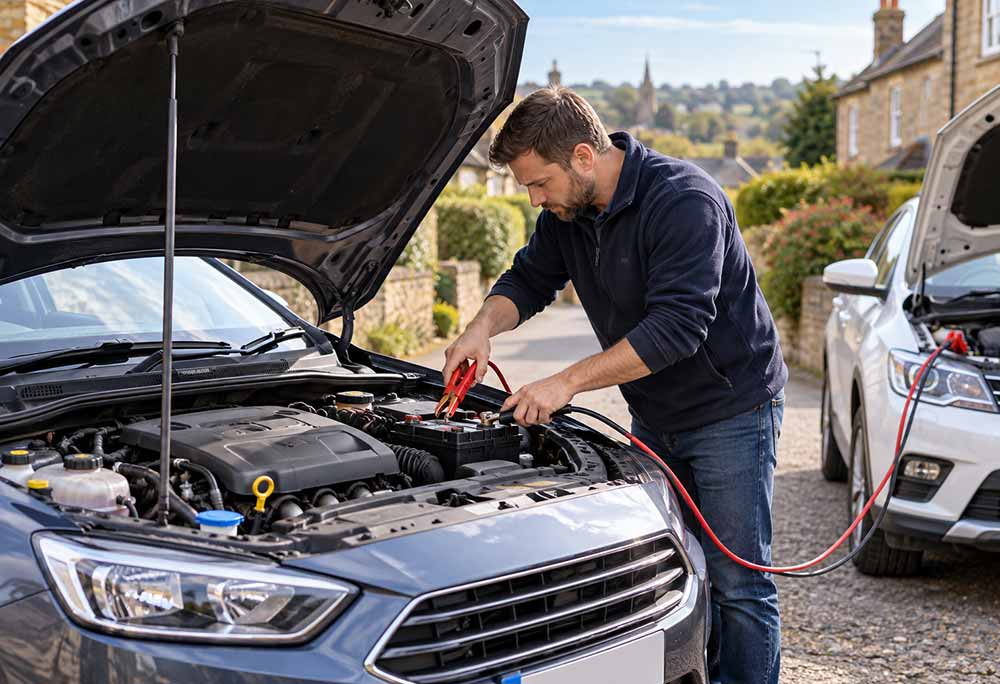
If your car battery is flat, switch off unnecessary electrical equipment, check for obvious battery problems and consider using jump leads or a suitable battery booster pack.
If the vehicle still won’t start, contact a garage or breakdown recovery service.
Before attempting anything, make sure your vehicle is parked safely with the handbrake applied.
If you’ve broken down on a busy road or motorway, prioritise your safety rather than attempting roadside repairs.
Look out for the following symptoms:
Engine won’t start: The engine struggles to turn over or doesn’t turn over at all.
Clicking noise: You hear a rapid clicking sound when attempting to start the engine.
Dim headlights: Your headlights or dashboard lights appear unusually dim.
Electrical problems: Central locking, electric windows or interior lights stop working.
Slow engine cranking: The engine turns over more slowly than usual.
Repeated starting difficulties: Your vehicle regularly struggles to start, particularly on cold mornings.
If you experience several of these symptoms, your battery may need charging, testing or replacing.
Jump starting is one of the quickest ways to get a vehicle running when its 12-volt battery has lost charge.
However, incorrect connections can damage sensitive vehicle electronics or cause injury. Always check your vehicle handbook before attempting a jump start.
You’ll need a suitable set of jump leads and another vehicle with a compatible, fully charged battery.
For conventional 12-volt vehicles, the basic connection procedure is:
Position both vehicles close together without allowing them to touch. Switch off the ignitions and apply both handbrakes.
Connect the red positive (+) lead to the flat battery’s positive terminal.
Connect the other red lead to the working battery’s positive terminal.
Connect the black negative (-) lead to the working battery’s negative terminal.
Attach the remaining black lead to the designated earthing point on the vehicle with the flat battery, away from the battery itself.
Follow the manufacturer’s starting instructions. Once the vehicle starts, disconnect the leads in reverse order, following the vehicle handbook.
Never attempt to jump start a damaged, leaking or frozen battery.
Important: Hybrid and electric vehicles can have different jump-starting requirements. Never use one as a donor vehicle unless its manufacturer specifically permits this.
Yes. If your battery is in good condition and has simply lost charge, it can often be recharged using a suitable car battery charger.
A smart battery charger can monitor charging progress and help prevent overcharging.
Choose a charger compatible with your battery type, particularly if your vehicle has start-stop technology and uses an AGM or EFB battery.
Although driving after a successful jump start may replenish some charge, a dedicated charger is generally more effective for restoring a discharged battery.
Understanding why your battery has lost charge can help prevent the same problem happening again.
Cold weather: Low temperatures reduce battery performance and make starting the engine more demanding.
Short journeys: Frequent short trips may not give the alternator sufficient time to replenish the battery.
Leaving lights switched on: Headlights, interior lights and other electrical equipment can drain the battery while the engine is off.
Old battery: Most conventional car batteries last approximately three to five years, depending on usage and maintenance.
Faulty alternator: If the alternator isn’t charging correctly, the battery may gradually lose power while driving.
Electrical faults: Faulty wiring or accessories can continue drawing power when the vehicle is parked.
If your battery repeatedly goes flat, arrange a professional battery and charging-system inspection.
A flat battery doesn’t automatically need replacing. However, batteries naturally deteriorate over time and eventually lose their ability to retain sufficient charge.
Consider a replacement if your battery is more than three to five years old, regularly struggles to start the engine or fails a professional battery test.
A qualified technician can check battery health, charging performance and electrical connections before recommending replacement.
Many modern vehicles also require battery registration or coding after fitting a replacement, making professional installation particularly beneficial.
If your vehicle develops a problem on a UK motorway, safety must come first.
If possible, leave at the next junction or motorway services. Otherwise, move to an emergency area or hard shoulder.
Switch on your hazard warning lights. Where it is safe, leave the vehicle using the left-hand doors and move behind a safety barrier, well away from traffic.
Never attempt to jump start or repair your vehicle on the motorway.
If you’re stranded in a live traffic lane and cannot safely exit, remain inside with your seatbelt fastened, activate your hazard lights and call 999 immediately.
A few simple precautions can significantly reduce the risk of an unexpected breakdown.
Have your battery checked during routine vehicle servicing.
Avoid leaving electrical equipment operating with the engine switched off.
Use a suitable maintenance charger if your car is regularly left unused.
Check that headlights and interior lights are switched off when parking.
Arrange an inspection if you notice slow starting or repeated electrical problems.
Consider a battery health check before winter.
Regular vehicle maintenance can identify a weakening battery before it leaves you stranded.
No. A flat battery cannot recharge itself. It requires an external battery charger or a functioning alternator while the engine is running.
A journey of around 30 minutes may restore some charge, but it won’t necessarily fully recharge the battery. The amount recovered depends on its condition, the alternator and driving conditions.
No. A flat battery cannot recharge itself. It requires an external battery charger or a functioning alternator while the engine is running.
Possible causes include an ageing battery, faulty alternator, electrical equipment drawing power while parked or a parasitic electrical drain. A garage can diagnose the underlying problem.
If your car won’t start, or you’re experiencing recurring battery problems, seeking professional assistance can save time and prevent further damage.
At our garage in Newbury we can test your battery, inspect the alternator and charging system, identify electrical faults and fit a suitable replacement battery if necessary.
Don’t ignore the early warning signs of a failing battery. Having your vehicle inspected promptly can help you avoid an inconvenient breakdown and keep your car reliable throughout the year.
📞 Contact Rayners to schedule a vehicle inspection and let our experts help you get back on the road safely.
